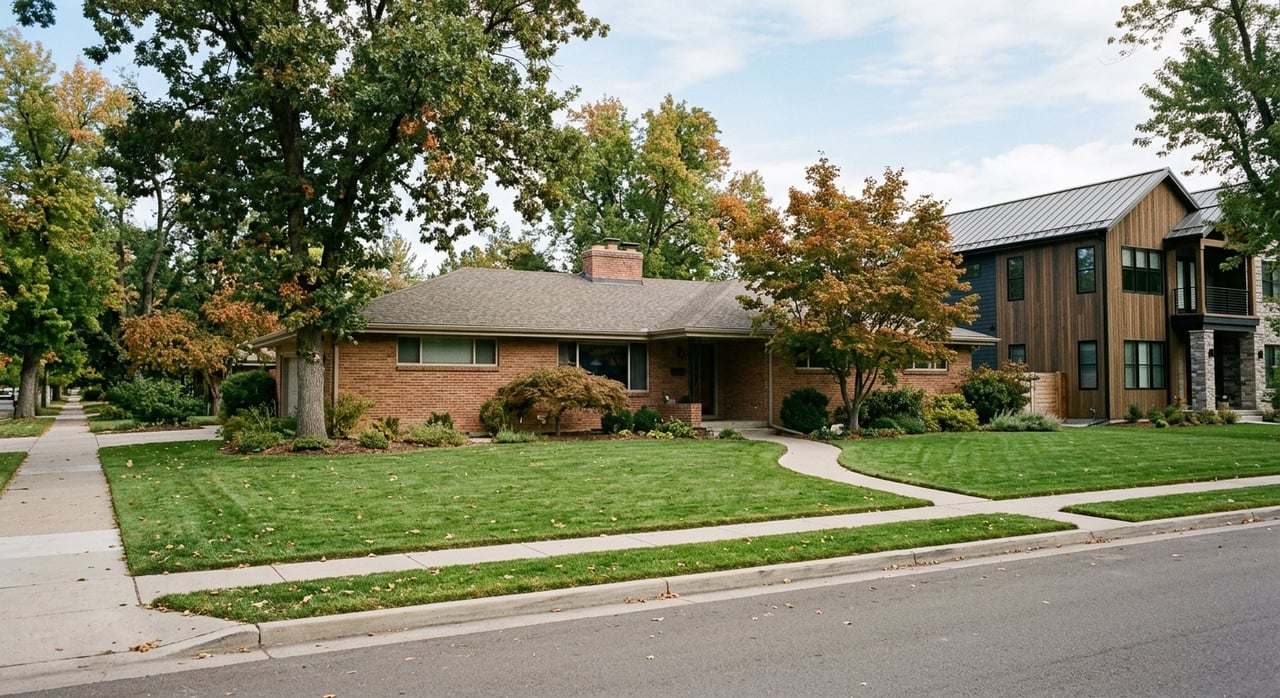
If you own a home in Hilltop, or you are considering buying one, you may be wondering how much of the property’s value comes from the house and how much comes from the land itself. In a high-priced neighborhood with large lots, layered architecture, and active buyer demand, that is an important question. Understanding lot value and redevelopment potential can help you make smarter decisions about pricing, renovating, rebuilding, or investing. Let’s dive in.
Why lot value matters in Hilltop
Hilltop is a largely residential neighborhood in east-central Denver, generally bounded by Colorado Boulevard, Holly Street, 8th Avenue, and Alameda Avenue. It is known for tree-lined streets, parks, and a mix of architectural styles that developed over time. That matters because in Hilltop, buyers may respond to both the site itself and the design of the existing home.
In some cases, a property’s value is strongly tied to its lot size, location on the block, and redevelopment potential. In others, the existing house adds meaningful value because of its design, condition, or architectural character. In Hilltop, it is rarely as simple as saying the land matters more than the structure.
Hilltop market signals to watch
Recent public market data point to a premium neighborhood where well-positioned homes still attract attention. Redfin reported a May 2026 median sale price of $1,895,852, with 40 homes sold and a median of 7 days on market. Zillow reported an average home value of $1,527,348 as of May 31, 2026, along with 43 homes for sale and 19 new listings.
Realtor.com’s April 2026 snapshot showed a median listing price of $2.3 million, a median sold price of $1.6325 million, 42 active listings, and 46 median days on market. These figures do not match exactly because each platform uses different methods and timeframes. Still, together they show a high-value neighborhood where pricing, positioning, and property details matter.
For homeowners, this kind of market can create a situation where an older or outdated house may be worth less for its current improvements than for the site it occupies. That is not a formal city rule or formula. It is a practical takeaway based on how buyers and developers may evaluate certain properties in a strong market.
How lot value is usually determined
Denver does not typically publish a standalone lot value for most occupied homes in the way many owners expect. The Denver Assessor says residential values are based on sales of similar homes within a 24-month period. Public property records can also include details like zoning and lot size.
That means lot value is usually inferred. People look at recent comparable sales, parcel dimensions, zoning, and what the site may allow now or in the future. In Hilltop, that process is especially important because redevelopment potential can vary significantly from one parcel to the next.
Key inputs that shape lot value
When evaluating lot value in Hilltop, a few factors tend to matter most:
- Exact lot size and dimensions
- Parcel-specific zoning
- Overlay status
- Block location and surrounding property patterns
- Existing house condition and usefulness
- Mature trees and setback constraints
- Alley access and curb-cut considerations
- Any review issues tied to demolition or new construction
A large lot with clear redevelopment potential may command a premium. A similar-sized lot with added permit friction or overlay restrictions may not pencil the same way.
Zoning is the first place to start
If you want to understand redevelopment potential in Hilltop, the first step is not guessing based on nearby construction. It is checking the parcel’s exact zoning and lot record. Denver uses context-based residential zoning districts, and building rights depend on the property’s specific district and any overlays that apply.
The city’s property record data can include zoning and lot size, which makes official parcel information a critical starting point. Two homes on the same street may look similar at a glance, but their redevelopment options can differ if their zoning or lot configuration is different.
Why parcel-level details matter
A redevelopment decision depends on what is allowed on that exact site, not what happened a few blocks away. You need to know whether the current parcel can support an addition, a new primary structure, or a change in lot configuration. Without that, any estimate of lot value is incomplete.
The Hilltop Heritage Conservation Overlay matters
One of the biggest issues in Hilltop is the Hilltop Heritage Conservation Overlay District, known as CO-1. Denver’s conservation overlay guidance says these overlays can apply to vacant or underused lots, exterior remodels, additions, and new construction. In other words, the overlay can affect much more than full redevelopment.
The zoning code also states that existing zone lots in CO-1 that existed on July 21, 2000, may be amended or subdivided only if the resulting lots are at least 75 feet wide and 9,300 square feet, subject to limited exceptions. If a parcel is inside CO-1, that can have a major effect on whether a lot split or redevelopment concept is realistic.
For owners and buyers, this means the lot may be valuable, but the path to unlocking that value may be narrower than expected. The site’s economics depend not just on demand, but on what the rules actually allow.
Renovation versus scrape-off in Hilltop
In Hilltop, the right strategy often comes down to a simple question: should you improve what is there, or replace it? The answer depends on the house, the parcel, and the approval path. It also depends on whether the market is likely to reward preservation, thoughtful updates, or a full rebuild.
Hilltop has real architectural depth. Denver Public Library materials note that the neighborhood developed in layers, shaped by major historical periods, and that architect Victor Hornbein designed many homes in Hilltop after World War II. The neighborhood also includes postwar modernist homes, including examples with flat rooflines, overhanging eaves, carports, and clerestory windows.
That history matters because some homes may carry value beyond square footage alone. A property with architectural distinction may be a better renovation candidate than a scrape-off, even in a neighborhood with expensive land.
When renovation may make sense
Renovation often fits best when:
- The home has architectural merit
- The structure is still serviceable
- The layout can be improved without major entitlement risk
- The parcel has constraints that make rebuilding more complicated
- The market is likely to value the home’s character
In these cases, updating the property may protect value while respecting what makes the home and block appealing.
When a scrape-off may make sense
A full rebuild may deserve a closer look when:
- The current structure is functionally obsolete
- The site could support a more marketable replacement
- The parcel’s zoning and overlay path are clear
- The lot dimensions work well for new construction
- The cost of renovation approaches the cost of rebuilding
In Hilltop, that analysis should include lot dimensions, alley access, mature trees, floodplain status, and likely permit review. Those factors can change both timeline and budget.
Permit and demolition friction can affect value
Redevelopment potential is not just about what is theoretically possible. It is also about how much time, cost, and uncertainty are involved. In Denver, demolition and rebuilding can be process-heavy.
The city says full or partial demolition requires a permit. Primary-structure demolition can also be delayed if Landmark Preservation believes the building may qualify as a landmark. Adjacent owners must receive 10 days of notice before demolition, and trees in protected setback areas must be retained or specifically authorized for removal.
Denver also notes that structural work is not handled as a quick permit. New buildings or additions for single-family homes, duplexes, and IRC townhomes require an issued Residential Construction Permit before trade quick permits can move forward. Even garage work can trigger multiple reviews involving zoning, building, sewer, curb cuts, and right-of-way.
For buyers and sellers, that means redevelopment potential is not just a yes-or-no issue. It is a timeline, cost, and risk issue too.
Questions to ask before assigning lot value
If you are trying to understand a Hilltop property’s true value, these are some of the most useful questions to ask:
- What is the exact zoning for the parcel?
- Is the property inside the CO-1 overlay?
- What are the lot width and total square footage?
- Does the house have architectural features the market may value?
- Would renovation cost less than rebuilding once permits and demolition are included?
- Are there mature trees, alley issues, or curb-cut concerns?
- Could floodplain or other reviews add time or cost?
These questions help move the conversation from guesswork to property-specific analysis. In a neighborhood like Hilltop, that is where better decisions usually begin.
What this means for buyers and sellers
If you are selling, understanding your lot’s redevelopment story can shape how your home is priced and marketed. Some buyers may focus on the current home, while others may be drawn to the site itself. Positioning the property correctly can help attract the right audience.
If you are buying, it is important to look beyond the house photos and square footage. A beautiful lot may come with overlay restrictions, tree constraints, or permit hurdles that affect your plans. On the other hand, a home that seems dated at first glance may sit on a parcel with strong long-term upside.
In Hilltop, lot value is best understood as a combination of three things: what public records show, what recent sales suggest buyers will pay, and what Denver’s zoning and permit rules actually allow. When you look at all three together, you get a much clearer picture of redevelopment potential.
If you want help evaluating how a specific Hilltop property fits into today’s market, reach out to Carol Hoffman for thoughtful, data-backed guidance.
FAQs
What affects lot value in Hilltop, Denver?
- Lot value in Hilltop is typically influenced by lot size, parcel dimensions, zoning, overlay status, existing home condition, architectural character, and the likely cost and complexity of redevelopment.
How do you check redevelopment potential for a Hilltop property?
- The best starting point is the parcel’s official property record, including zoning, lot size, and whether the Hilltop Heritage Conservation Overlay District applies.
What is the CO-1 overlay in Hilltop?
- CO-1 is the Hilltop Heritage Conservation Overlay District, and it can affect additions, exterior remodels, new construction, and lot changes such as certain subdivisions.
Should you renovate or rebuild a home in Hilltop?
- That depends on the home’s architectural merit, structural condition, layout potential, zoning, overlay rules, and the likely time and cost involved in demolition and new construction.
Why can two Hilltop lots have different values?
- Two lots can differ in value because of zoning, overlay restrictions, width, square footage, alley access, tree constraints, and how easily each site can be renovated or redeveloped.